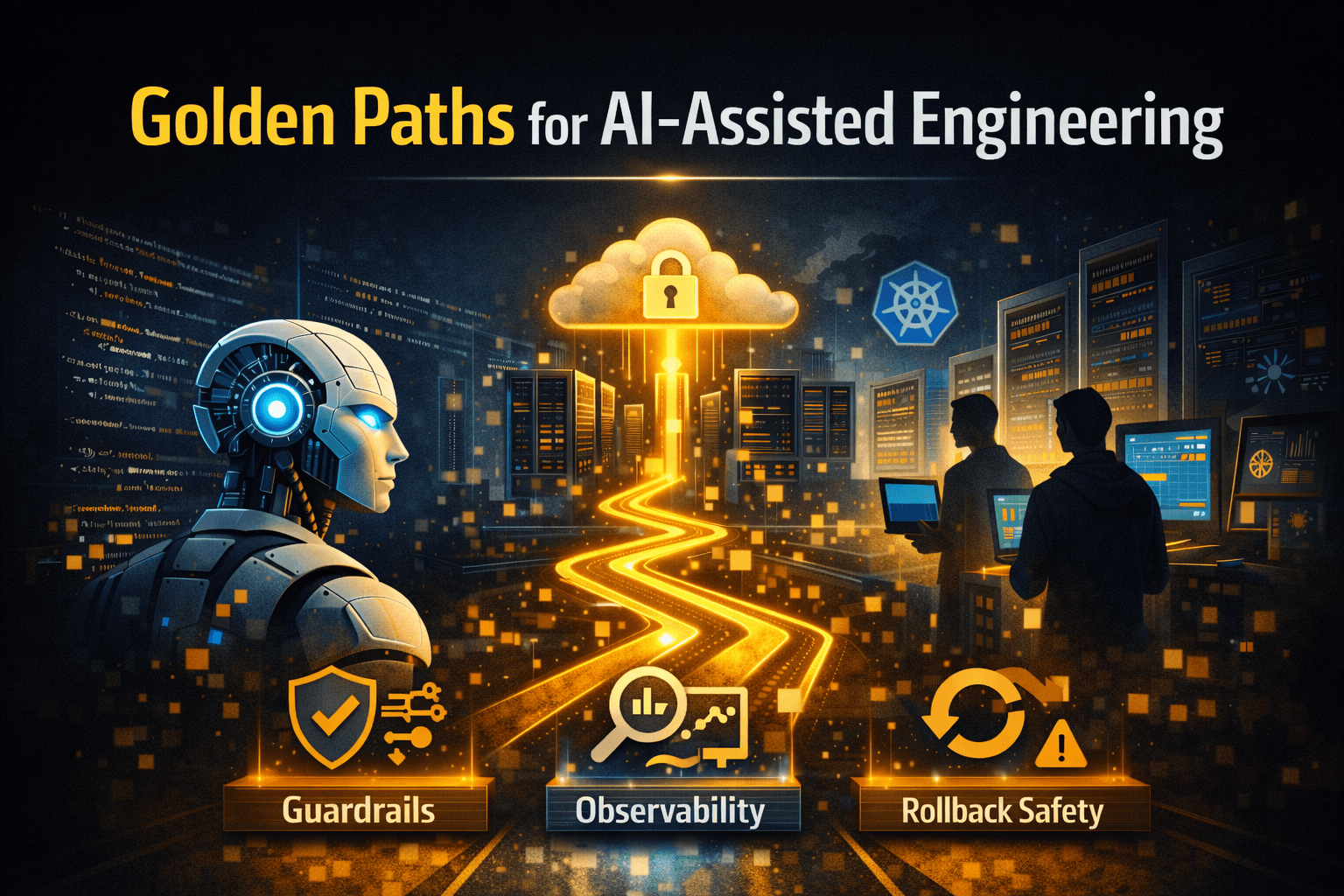
Golden Paths for AI-Assisted Engineering
AI can now generate code fast enough that many teams are asking the wrong question.
The question is not:
“How do we get AI to write more code?”
The better question is:
“How do we let humans and AI ship faster without increasing incidents, regressions, and operational chaos?”
That is where I help.
I work at the intersection of software architecture, SRE, and hands-on development. My focus is not just writing code or drawing system diagrams. My focus is building the engineering system around delivery: the architecture, deployment model, observability, runtime safety, and platform standards that determine whether speed becomes leverage or liability.
If your team is moving quickly but production feels fragile, or if AI-assisted development is increasing output without increasing confidence, this is exactly the kind of problem I solve.
The problem most teams actually have
Many teams think they have an AI problem.
In reality, they usually have one of these problems:
- releases are too risky
- delivery depends on tribal knowledge
- production issues take too long to detect or diagnose
- architecture is drifting across services and teams
- observability is inconsistent
- platform standards exist in documents but not in tooling
- AI-generated code gets merged faster than the system can safely absorb it
AI simply exposes these weaknesses faster.
When code generation becomes cheap, the bottleneck moves somewhere else:
- design quality
- review quality
- operational visibility
- deployment safety
- ownership clarity
- system constraints
That is why the real work in 2026 is not prompt engineering alone. It is engineering-system design.
How I help
I help teams build golden paths: opinionated, repeatable ways to design, build, deploy, and operate software safely.
That usually means I step into problems like these.
1. “Our teams move fast, but every release feels risky”
This usually points to weak release engineering, inconsistent standards, or a lack of confidence in rollback and runtime visibility.
I help by designing:
- safer CI/CD workflows
- progressive delivery patterns
- release validation checks
- rollback strategies
- deployment guardrails
- service maturity standards
The goal is simple: shipping should feel routine, not heroic.
2. “We have observability tools, but incidents still take too long to understand”
Having dashboards is not the same as having observability.
I help teams define and implement:
- structured logging standards
- trace and metric conventions
- service health contracts
- ownership metadata
- alerting with real operational meaning
- better signal around latency, failure, and dependency behavior
The result is that when something breaks, your team can answer three questions quickly:
- what is failing
- where it is failing
- what changed
3. “Our architecture looks fine on paper, but delivery is messy”
A lot of systems fail not because of one bad design decision, but because the architecture does not translate into developer workflow.
I help close that gap by aligning:
- architecture decisions
- repository structure
- service boundaries
- platform capabilities
- infrastructure standards
- operational responsibilities
A good architecture should reduce ambiguity, not create more of it.
4. “AI is helping developers write code, but we do not trust the output in production”
This is now one of the most important engineering problems.
AI-generated code is often plausible, but plausibility is not production readiness.
I help teams create the constraints that make AI assistance useful:
- service templates
- coding and review standards
- CI enforcement
- policy-as-code
- observability requirements
- security and secrets boundaries
- rollout safety defaults
The principle is straightforward:
AI should accelerate implementation, not bypass engineering discipline.
5. “Every team does things differently, and scaling is getting painful”
This is a classic platform engineering problem.
I help define and implement internal standards such as:
- golden service templates
- paved-road deployment workflows
- default telemetry setup
- infrastructure patterns
- dependency boundaries
- ownership and lifecycle conventions
This reduces drift, lowers cognitive load, and makes the system easier to evolve.
What a golden path really means
A golden path is not a recommendation buried in a wiki.
It is the default operational route through the engineering system.
That can include:
- service scaffolding
- standard CI pipelines
- deployment templates
- runtime instrumentation
- policy checks
- environment conventions
- ownership definitions
- release safety mechanisms
When a golden path is implemented well, developers do not need to remember every best practice manually. The platform carries those decisions for them.
That is also what makes AI more useful.
AI works better in systems with clear structure. If every service has different conventions, the quality of generated output becomes inconsistent and review becomes expensive. If the system has a strong contract, AI can operate inside safer boundaries.
That is why I see platform design as one of the best multipliers for both developer productivity and reliability.
My approach
I typically approach these problems in four layers.
Architecture
I look at service boundaries, coupling, scaling assumptions, failure domains, and where the current design creates delivery friction.
Questions I care about include:
- where is complexity accumulating
- what is tightly coupled that should not be
- which boundaries are unclear
- what assumptions are hidden inside the runtime behavior
Delivery
I examine how code moves from commit to production.
That includes:
- build pipelines
- test gates
- promotion strategy
- deployment automation
- rollback capability
- release controls
A fast pipeline is not enough. It needs to be trustworthy.
Operations
I look at how the system behaves when things go wrong.
That includes:
- logs, metrics, and traces
- alert quality
- service ownership
- incident response readiness
- runtime diagnostics
- change correlation
This is where many teams discover that they are collecting data without creating operational clarity.
Developer experience
I also care about whether the system is easy to work in.
That includes:
- templates
- local setup
- platform friction
- documentation quality
- consistency across services
- how much tribal knowledge is required to ship safely
Good developer experience is not separate from reliability. In mature systems, the two reinforce each other.
What readers can expect from this blog
This blog is for engineering leaders, architects, SREs, and developers who care about building systems that are not only scalable, but operable.
You can expect writing about topics like:
- architecture decisions with operational consequences
- SRE practices that improve delivery, not just uptime
- observability that helps teams debug real systems
- platform engineering and paved roads
- AI-assisted development with production-grade guardrails
- release engineering, reliability, and service ownership
- practical patterns for reducing complexity
I will focus on problems that appear in real teams, such as:
- unstable releases
- fragmented platform standards
- poor visibility during incidents
- growing service sprawl
- delivery pipelines that do not scale
- AI adoption without engineering controls
And I will write from the perspective of someone who cares about both the design and the implementation.
What I can help with directly
If you are dealing with issues like these, I can help:
- modernizing delivery workflows without increasing risk
- designing safer CI/CD and release processes
- improving observability and operational diagnostics
- defining platform standards and golden paths
- reviewing architecture through an SRE lens
- making AI-assisted engineering safer and more predictable
- reducing drift across services, repos, and teams
- turning reliability practices into developer-friendly defaults
In practical terms, that means I can help you move from:
- fragile releases to repeatable deployment confidence
- unclear signals to useful observability
- architectural drift to consistent engineering standards
- AI-generated uncertainty to guardrailed delivery
- tribal knowledge to platform-supported workflows
Closing thought
The future of engineering is not just faster code generation.
It is better systems for turning change into safe production outcomes.
That requires architecture that respects operational reality, SRE practices that influence delivery early, and platform standards that make the right path the easiest one.
That is the work I care about.
And that is what this blog is about.